The Chinese American Archive is a student-led organization dedicated to preserving and amplifying the voices of Chinese Americans through storytelling. We strive to celebrate our culture, uplift community narratives, and foster cross-generational solidarity. By uncovering and sharing the stories of our past and present, we honor our heritage, confront erasure, and inspire a deeper understanding of what it means to be Chinese American—yesterday, today, and tomorrow.
Explore a curated collection of articles, websites, and research materials covering the history, culture, and evolving identity of Chinatowns across the United States.
–Curated by Angelina, Flintridge Preparatory School, La Cañada Flintridge, California
Unlock the past, ignite our future.
- How American Chinatowns Emerged Amid 19th-Century Racism — History.com, by Rachel Chang. A look at how and why Chinatowns formed in response to racism, exclusion laws, and economic pressures. (HISTORY)
- Preserving Chinatowns: How Many Are at Risk of Being Lost? — National Parks Conservation Association. Discusses threats to physical heritage and cultural identity in Chinatowns. (National Parks Conservation Association)
- What Chinatowns Can Teach Us About Community — Institute for Policy Studies (IPS-DC). Examines how Chinatowns developed, how they function, and the pressures of gentrification. (Institute for Policy Studies)
- Researching the History of Boston’s Chinatown — Boston Public Library blog. Offers specific resources & a historiographic guide for Boston, as a case study. (Boston Public Library)
- An Early History of Boston's Chinatown — National Park Service. History from first Chinese immigration in New England through cultural development. (National Park Service)
- The Rise and Fall of Denver’s Chinatown — History Colorado. Focuses on aonce-vibrant Chinatown in Denver, its decline, and what remains. (History Colorado)
- In Fast-Changing Chinatown, a Struggle to Preserve Traditions Amid Development — The Washington Post. Looks at Washington, D.C.’s Chinatown, how it evolved, and how residents cope with change. (The Washington Post)
- D.C.’s Chinatown Has Only 300 Chinese Americans Left … and Fighting to Stay — Washington Post. Demographic shifts and identity issues in Washington, D.C.’s Chinatown. (The Washington Post)
- The Transformation of New York’s Chinatown in the 1980s — Washington Post. Documentary-photography approach to show the evolution of NY Chinatown social life and population since liberalized immigration. (The Washington Post)
- Chinatowns Are Struggling to Survive. Grace Young Is Reminding Americans Why They Matter. — Washington Post. Discusses COVID, anti-Asian violence, and how Chinatown neighborhoods across the U.S. are vulnerable. (The Washington Post)
- LA Chinatown Asian Massacre Podcast / “Blood on Gold Mountain” — Washington Post. Covers a specific violent event in 1871 in Los Angeles’s Chinatown, but also how history is remembered (or lost). (The Washington Post)
- The Story of Chinatown — PBS / KQED. Offers a history resource guide (especially for San Francisco). (PBS)
- The Chinatown Atlas — referenced in the Boston Public Library’s resources. It’s an interactive historical resource showing spatial and temporal change. (Boston Public Library)
- Boston Chinatown History Directory & Heritage Trails — from BPL. Useful for site-specific research and primary sources. (Boston Public Library)
- Chinatown House (Rancho Cucamonga, CA) — Historic building, example of Chinese worker housing; part of the architecture / heritage preservation conversation. (Wikipedia)
- Chinese Historical Society of America (San Francisco) — museum + archive documenting Chinese American history, especially in Chinatowns. (Wikipedia)
- Oakland Chinatown Night Market revival post-pandemic — SF Chronicle. Shows how community and culture are being used to revive Chinatowns after COVID disruptions. (San Francisco Chronicle)
- San Francisco’s Chinatown Resists Gentrification — Axios. Focuses on the pressures San Francisco Chinatown faces with property costs, redevelopment, and attempts to move out low-income residents. (Axios)
- Long-awaited renovation of S.F.’s oldest park moving forward in Chinatown (Portsmouth Square) — SF Chronicle. Looks at how public spaces in Chinatown are being renovated (and the contestations around them). (San Francisco Chronicle)
- Tony Cheng’s, a D.C. Chinatown mainstay for decades, fights for survival — Washington Post. A portrait of a longtime restaurant threatened by economic pressures. (The Washington Post)
yours truly, China: A student-led podcast
“yours truly, China,” a cultural podcast founded and hosted by Jessica Li, aims to share and honor the immigrant stories of Chinese Americans and their role in today’s American society. The podcast features long-form interviews with immigrants that have diverse roles and professions in society, such as college professors, startup CEOs, Chinatown tour guides, and more to come. The logo is a golden venn diagram: one circle represents the US, the other circle represents China, and the middle area of intersection represents the bridge between the two cultures and lifestyles. Thus, this podcast hopes to explore and better understand the “intersection area” through meaningful, culturally-sensitive conversations.
Listen here: https://open.spotify.com/show/3eId5R3I3Ami9O55tL5bQ2?si=671b92aaa07a4a02.
2026 San Francisco Chinatown Field Trip
Video created by Steven Liu
Bruce Lee: Beyond the Suit
Created by Kevin Han, Athenian School Danville, CA
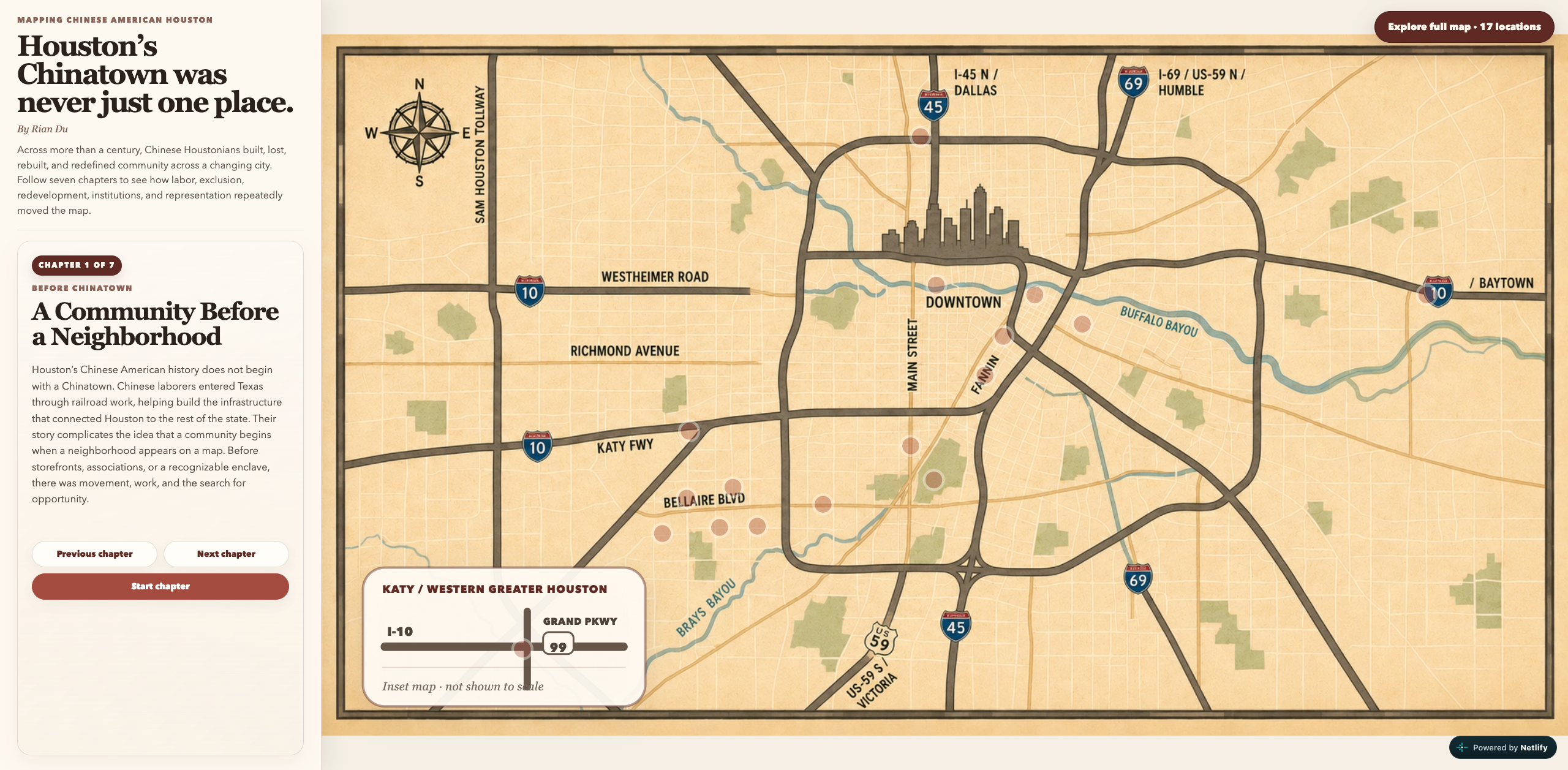
Houston Chinatown Map
Across more than a century, Chinese Houstonians built, lost, rebuilt, and redefined community across a changing city. Follow seven chapters to see how labor, exclusion, redevelopment, institutions, and representation repeatedly moved the map.
Click the image below to explore the Houston Chinatown interactive map (Created by Rian Du)